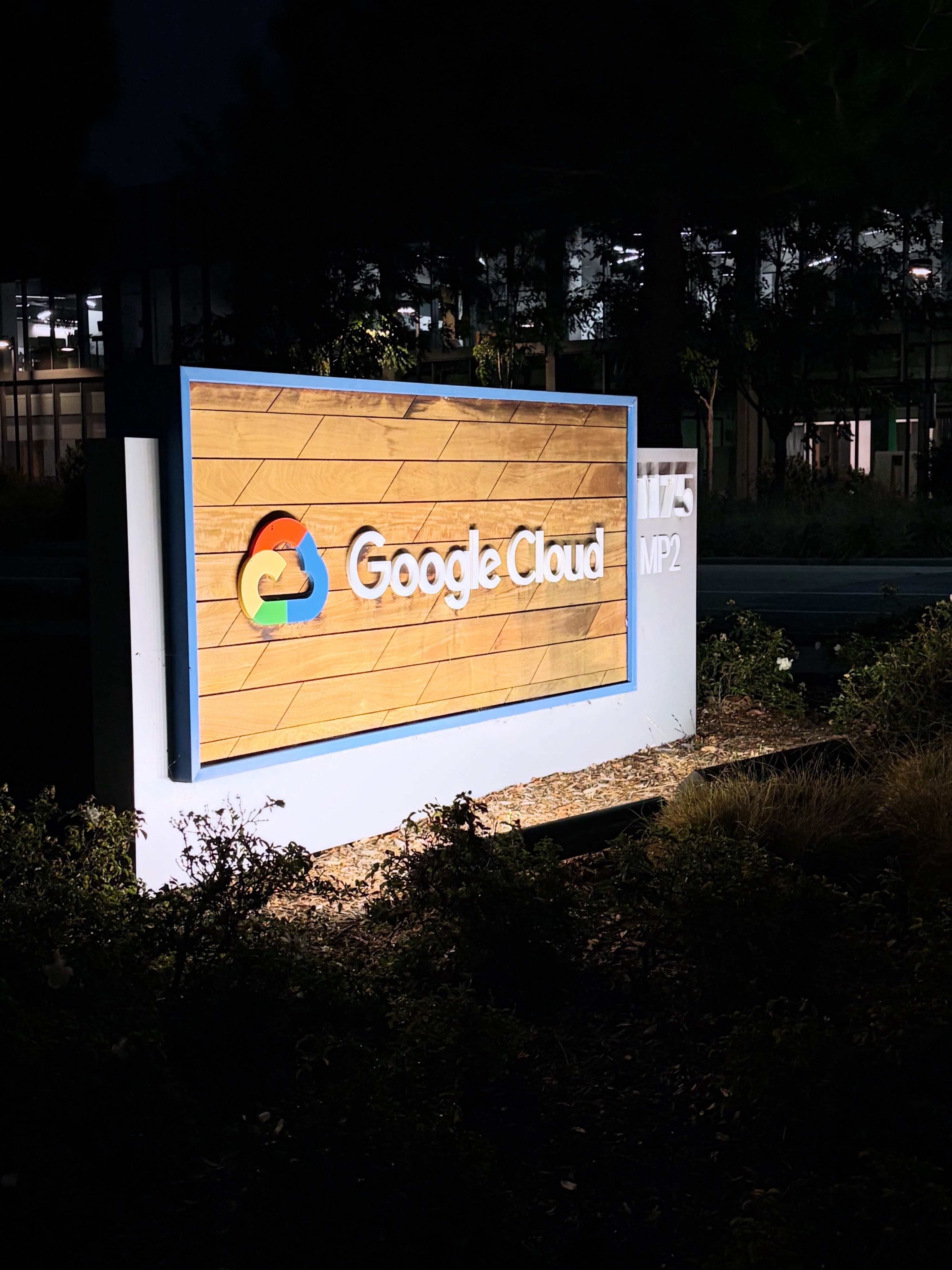
When an invite landed in my inbox for a private engineering forum at Google Cloud's campus in Sunnyvale, I thought it was spam. Google inviting me to talk directly with hiring managers and engineers working across Cloud AI and Security Operations? It felt a little too good to be true, but it was real.
I hopped in my car and headed straight over. After grabbing my lanyard, I saw a buffet table filled with engineers chatting across different circles. One immediate win: I was glad I ate beforehand. Balancing a plate of food while networking is definitely not my strong suit, and the last thing I needed was to spill sauce on myself.
The room had a relaxed vibe. The dress code was totally open, ranging from t-shirts and jeans to full suits. It was interesting seeing the range of comfort engineers attending showed.
How Google talks about engineering impact
The first portion kicked off with a panel featuring leaders across Business Applications, Cloud AI, and Cloud Security Operations. Hearing them break down how Google structures engineering impact was great context. An L4 engineer focuses on well-defined, local team problems, while an L5 tackles ambiguous system architecture across teams.
One point from the VP speaker, Rao Surapaneni, really hit home. He emphasized that he values engineers who are "Swiss army knives": developers who can step outside their immediate day-to-day box, who understand business logic, UX, full-stack pipelines, and product management. Hearing that was validating. It mirrors how I approach software and the exact advice I give other engineers.
After the panel, the room split into breakout sessions for Cloud Security Operations and Cloud AI. I spent a lot of time diving into the architecture behind both teams, and several practical lessons stood out.
1. AI agents aren't magic fixes: know when to go deterministic
There is a massive industry push to replace proven legacy components with end-to-end AI agents. But foundation models are probabilistic, while production platforms demand deterministic reliability.
During the panel, the Gemini team shared a great real-world lesson from building customer support agents. When they replaced a legacy system that handled credit card number audio recognition with an agentic LLM workflow, accuracy dropped whenever background noise interfered. The general agent simply could not match the reliability customers were used to with the older, dedicated system.
That exact scenario mirrored my own research building an animated desktop voice agent at Vaughn Industries. I tested having an agent process raw audio streams directly for wake-word detection, and it struggled. It is hard to beat a traditional, narrow model trained on thousands of varied vocal inflections.
The takeaway: do not use an expensive frontier model where a lightweight regex, traditional acoustic classifier, or rigid deterministic check does the job better. Isolate model reasoning strictly to areas where ambiguity is required, and wrap the output in rigid schemas, strict typing, and validation filters.
2. Threat detection in security operations: dynamic at scale
I was surprised by how deeply AI is woven into Google Cloud Security Operations. Rather than just using models to write summaries, they deploy AI agents directly into enterprise environments to parse massive streams of telemetry and security logs.
Instead of retraining traditional models on rigid anomaly definitions, adaptive agent pipelines interpret evolving threat patterns dynamically without needing full core model retraining.
However, giving autonomous agents access to enterprise security environments introduces real risk. The panel stressed critical guardrails:
- Least privilege: restrict an agent's tool access and execution scope to the bare minimum required for the task.
- Evidence over fluency: a security analyst needs raw log citations and observable intermediate reasoning steps, not just a persuasive paragraph.
- Action gating: high-impact or irreversible operational steps must always require human verification.
3. The real frontier is evaluation and observability
In traditional software, testing is straightforward. When I write a function in code, I can write a unit test to see what happens with certain arguments, pass mock values, and test edge cases. AI agent evaluations are nowhere near that simple.
Evals are where AI engineers spend the bulk of their time. Right now, teams have to manually curate or synthesize golden datasets of question sets to simulate agent behavior. Even then, you often cannot catch critical edge cases until real customers use the product.
To make things harder, aggregate benchmark numbers often mask major failures. An assistant boasting a 95% overall task completion rate can easily hide a 60% failure rate for a specific accent, dialect, or noisy microphone input. Until generalized evaluation frameworks mature, deep tracing is essential. You have to log every context retrieval, prompt state, tool invocation, and fallback path to catch degradation before your users do.
4. Unit economics: measure cost per successful outcome
With agentic loops, a single prompt can silently spawn multiple web searches, vector lookups, model calls, tool executions, and retries. Treating inference as a negligible line item during early prototyping quickly leads to unsustainable cloud bills.
Sustainable production systems keep costs under control by:
- Context caching: caching static system prompts, enterprise schemas, and tool definitions.
- Tiered routing: sending simple classification or extraction tasks to compact, cost-effective models while reserving frontier reasoning models for complex planning.
- Workflow accounting: tracking total compute, latency, and operational expenses per successful business result, rather than looking only at isolated API token pricing.
5. Riding the wave: why the "Swiss army knife" wins
The pace of generative AI moves so fast that best practices shift every three to four months. Rather than trying to memorize every temporary framework, the most valuable skill is remaining agile and learning by building.
While sitting at a conference table, I asked the engineers around me how many of them had actively built applications on Google Cloud Platform. Not a single person raised their hand. When I wanted to understand Google Cloud's capabilities, I did not just read documentation. I architected and launched OpenUp, an AI game that scaled to 1,200+ users on Cloud Run and Firebase. Building hands-on forced me to solve real problems around cold starts, state persistence, and cost optimization.
Expanding your scope beyond your immediate silo makes you a significantly better engineer. In my past work at TCWGlobal, I made it a priority to meet people in every department, including sales, recruiting, and operations. Understanding how software impacts real end users and internal stakeholders completely changes how you design systems.
Practical networking takeaways
I finished the night talking with a recruiter about Senior AI/ML and Full Stack roles, and then quickly grabbed some of the food I had passed on earlier as security announced the event was wrapping up.
Watching the room gave me two clear reminders for anyone attending technical invite-only events:
- Skip the silent resume drop. Some attendees nervously handed printed resumes to hiring managers and walked away. If you were invited to a private forum, the recruiting team already has your profile. What they want is a genuine sense of your communication, curiosity, and technical perspective.
- Bring business cards. Handing someone a physical sheet of paper leaves them stuck carrying it around all night. A business card with your contact links is frictionless to pocket and easy to follow up on. It is a fantastic habit I picked up while traveling in Japan.
Conclusion
Generative AI is shifting software engineering upward in abstraction. As models generate more routine boilerplate code, our core value as engineers lies in system judgment: architecting reliable boundaries, designing for diverse edge cases, securing data flows, and making sure probabilistic models deliver dependable results.
It was deeply refreshing to spend an evening with engineers who genuinely love tackling complex problems.